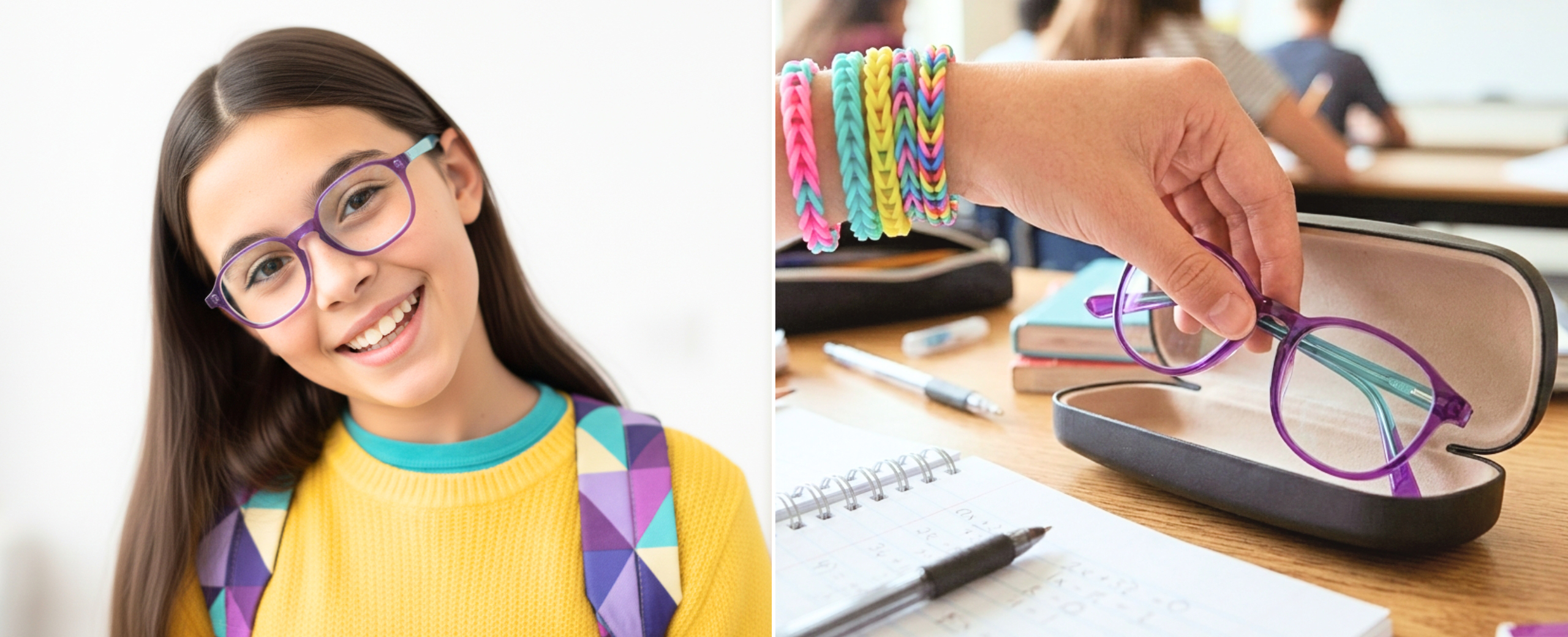
Children’s glasses: good vision begins with proper use.
When a child starts wearing glasses, something interesting happens.
At first, they observe them, touch them, try them on, take them off and put them back on again. It’s perfectly normal: they are getting familiar with a new object that suddenly becomes part of their daily life.
And it’s exactly at this stage that an important question arises:
how are glasses perceived?
As a toy?
As just another accessory?
Or as something that truly serves a purpose?
Flexible, yes. Unbreakable, no. And above all: not toys.
Today’s glasses are designed to accompany children in their world of movement, energy and spontaneity.
Materials are lighter, more comfortable and more flexible than in the past. And that is a great achievement.
But here’s an important point: flexibility is not an invitation to bend, pull, twist or “test” the frame.
It is simply an extra safety feature designed to handle the unexpected moments of real life — not to turn glasses into a toy.
Think of it like a sturdy school backpack: it can carry the weight of books, but that doesn’t mean it should be dragged on the ground or used as a sled.
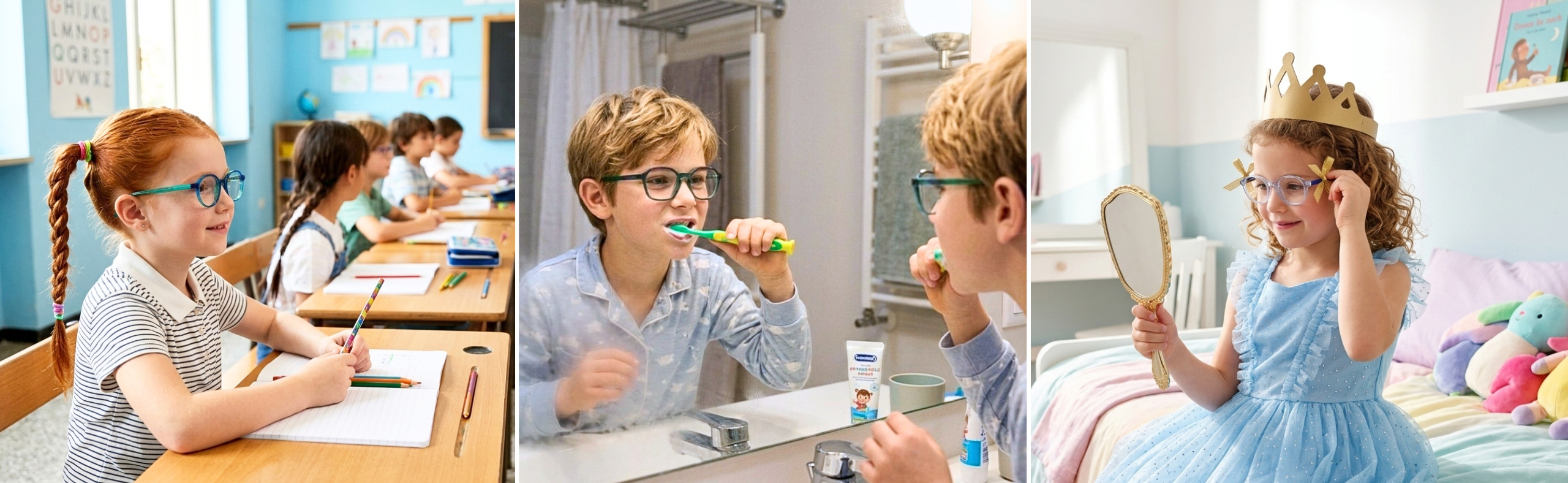
Every object has its purpose (and its proper way of being used)
No one would use a bicycle helmet as a ball.
No one would play football with a tennis racket.
And no one would use a remote control as a toy car, even if “it’s durable”.
Not because these objects are fragile, but because they are designed for a specific purpose.
Glasses work the same way.
They are designed to sit on the face, in a precise position, allowing the lenses to do their job properly.
When they are bent, distorted or worn incorrectly, it’s not only the frame that suffers — the quality of vision is affected as well.
Why wearing them properly really makes a difference
A properly adjusted frame helps the lenses work in the correct position in front of the eyes.
This means clearer vision, less strain and more effective correction throughout the day.
Over time, wearing glasses correctly can also help slow the progression of certain visual conditions and improve a child’s overall visual comfort.
On the other hand, glasses that are crooked, loose or constantly taken off and put back on like a toy lose part of their function.
Not because the glasses aren’t good — but because they are not being used as intended.
Learning how to use them: a shared responsibility
This is where two key figures come into play: parents and opticians.
Parents have the often underestimated role of conveying the value of the object. Not as something “boring” or imposed, but as an ally that helps the child feel and see better.
Opticians, on the other hand, do much more than sell glasses. They explain, guide and educate.
Clarifying that flexibility is an advantage — but that glasses are not a toy — helps create awareness and realistic expectations.
And when a child understands that:
• those glasses truly help them
• they are not a toy, but not a punishment either
• they are part of their daily routine
then something changes in the way they treat them.
They don’t need to be indestructible. They need to be respected.
The real challenge is not finding glasses that will never break.
The real challenge is teaching that every object has value when it is used in the right way.
When this message gets through, something simple but powerful happens:
glasses stop being something to “put up with” and become a trusted companion.
And that’s when vision — and everyone who works every day to protect it — benefits the most.